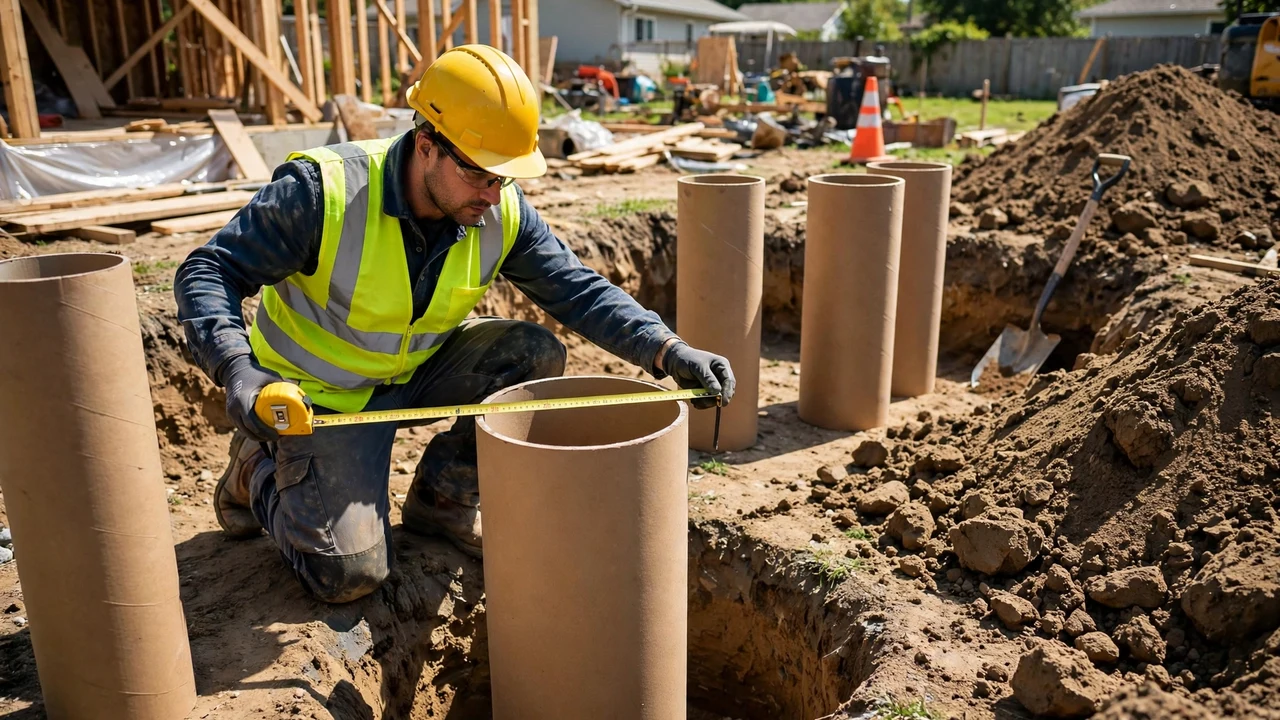
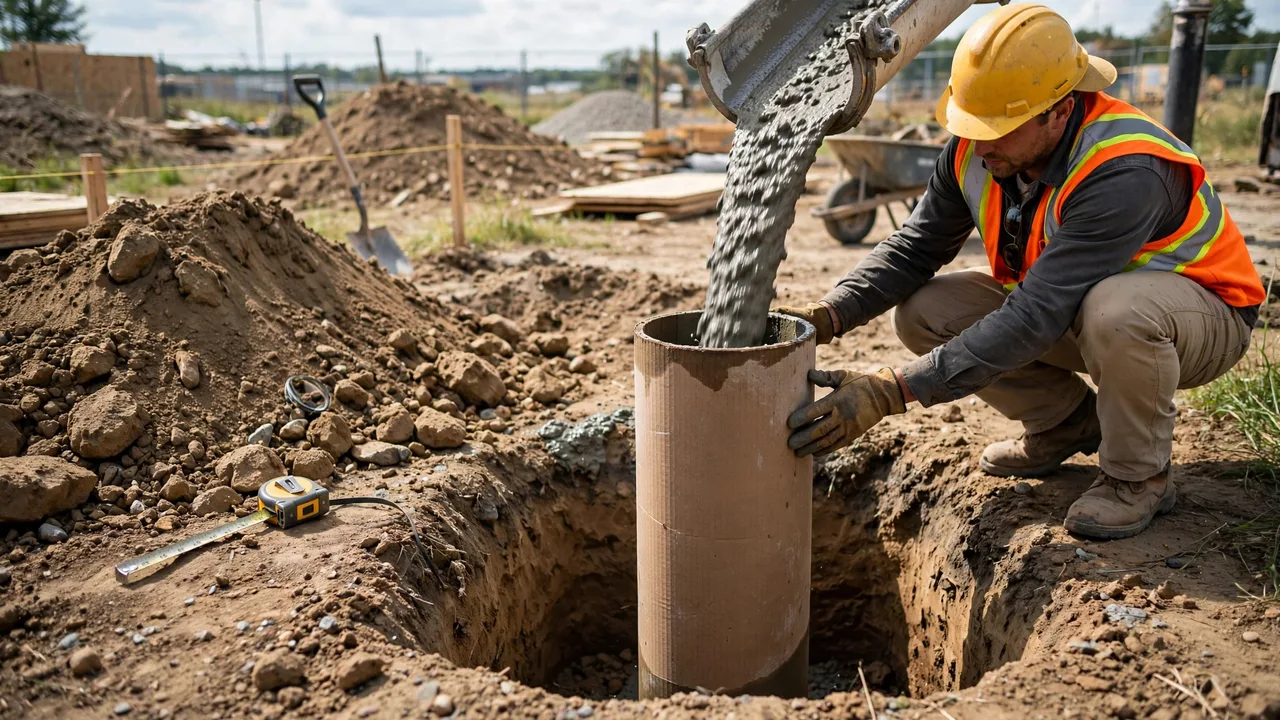
A pier footing pour has 2 parts: the wider base pad and the pier shaft that sits on it. Enter both and the calculator returns the geometric pour volume, then adds a waste percentage only when you have a project reason for it.
How much concrete does a pier footing need?
You need the measured pad-plus-shaft volume plus a documented waste allowance. The calculator shows the measured result first in cubic yards and cubic feet, or cubic metres and litres, and keeps it visible while a user-entered waste percentage builds a separate planning volume. The pier footing measurement guide shows where to take each dimension in the field.

What does each pier footing result mean?
| Result | Calculation | Use |
|---|---|---|
| Base pad per pier | Pad cross-section × pad thickness | Checks the wider base on its own line |
| Pier shaft per pier | Pier cross-section × pour height | Checks the shaft on its own line |
| Measured concrete volume | (Pad + shaft) × number of piers | Unadjusted geometric quantity |
| Measured equivalent | Measured volume in the second unit set | Cross-checks cubic feet against cubic yards, or litres against cubic metres |
| Planning volume | Measured volume × entered allowance factor | Documented pre-order quantity |
The calculator reports cubic metres and litres in metric mode. Imperial mode reports cubic yards and cubic feet. It retains full precision through the calculation and rounds only the displayed values.
What formulas does the Pier Footing Concrete Calculator use?
The calculator converts the entered dimensions to the base linear unit (metres or feet), computes each cross-section, multiplies by the thickness or height, adds pad and shaft, then multiplies by the pier count.
Square pad volume = side × side × pad thickness
Round pad volume = π × (diameter ÷ 2)² × pad thickness
Square pier volume = side × side × pour height
Round pier volume = π × (diameter ÷ 2)² × pour height
Measured volume = (pad volume + pier volume) × number of piers
Planning volume = measured volume × (1 + waste % ÷ 100)
| Displayed conversion | Relationship | Calculator use |
|---|---|---|
| Centimetres to metres | 100 cm = 1 m | Metric dimension entries |
| Inches to feet | 12 in = 1 ft | Imperial dimension entries |
| Cubic feet to cubic yards | 27 ft³ = 1 yd³ | Imperial measured and planning volume |
| Cubic metres to litres | 1 m³ = 1,000 L | Metric equivalent volume |
NIST Handbook 44 Appendix C supplies the cited volume relationships. Unit switching converts populated dimensions and clears the displayed result, so a fresh calculation runs in the selected units.
Worked imperial example
One pier footing has a 24 in diameter round pad that is 8 in thick, and a 12 in diameter round pier poured 48 in high, with a documented 10% waste allowance.
- Pad cross-section: π × 12² = 452.3893 in². Pad volume: 452.3893 × 8 = 3,619.1147 in³.
- Pier cross-section: π × 6² = 113.0973 in². Pier volume: 113.0973 × 48 = 5,428.6726 in³.
- Volume in cubic feet: (3,619.1147 + 5,428.6726) ÷ 1,728 = 5.23599 ft³.
- Measured volume: 5.23599 ÷ 27 = 0.19393 yd³.
- Planning volume at 10% waste: 0.19393 × 1.10 = 0.21332 yd³, or 5.75959 ft³.
Measured result: 0.194 yd³ and 5.236 ft³. Planning result: 0.213 yd³ with the entered 10% waste. The waste stays visible as a separate assumption.
Worked metric example
4 identical piers each have a 600 mm square pad that is 200 mm thick and a 300 mm square pier poured 1.2 m high, with no waste entered.
- Pad volume per pier: 0.6 × 0.6 × 0.2 = 0.072 m³.
- Pier volume per pier: 0.3 × 0.3 × 1.2 = 0.108 m³.
- Per-pier total: 0.072 + 0.108 = 0.180 m³.
- Measured volume: 0.180 × 4 = 0.720 m³.
- Equivalent volume: 0.720 × 1,000 = 720 L.
Measured result: 0.72 m³ and 720 L. With 0% waste the planning volume is identical, so the record shows one checkable number.
Why measure the inside diameter of a round tube?
Sonoco's Builder's Tube product data states that tube diameter sizes are nominal, and adds that you need to measure when the quantity is critical. Concrete fills the inside of the tube, so the inside diameter controls the volume.
Measure across the inside of the opening at 2 perpendicular positions near the top of the tube and average the 2 readings. A geometry check agrees with the manufacturer's chart direction: a nominal 12 in tube holds π × 6² × 12 ÷ 1,728 = 0.785 ft³ per foot of height at exact nominal size, while Sonoco's chart quotes 0.80 ft³ per foot, consistent with an inside diameter at least as large as the label size.
Common pier footing concrete mistakes
- Entering the tube label size instead of a measured inside diameter.
- Measuring the pour height from the top of the tube instead of from the planned concrete top.
- Using one count for piers with different pad or tube dimensions.
- Leaving the pad out of the calculation for a tube-only quote.
- Entering centimetres in a metres field or inches in a feet field.
- Using the excavation diameter as the concrete diameter.
- Applying waste before preserving the measured volume.
- Using a borrowed waste percentage as if it were measured.
- Treating the planning volume as a check that the footing is sized correctly.
- Treating a quantity result as approval of footing design.
What does this calculator not do?
This calculator computes concrete quantity. It does not size the footing, set frost depth, assess soil bearing, design reinforcement, select concrete strength, or confirm code compliance. Those are structural design decisions for the project drawings and the responsible professional. Quantity planning never replaces them.
Tapered or belled piers, stepped pads, and piers with embedded post displacement need geometry or tools suited to that condition. For an embedded post, use the Concrete Post Hole Calculator. For a full-height column without a pad, use the Concrete Column Calculator.
When should piers share one calculation?
Use the pier count only when every pier has the same pad shape, pad size, pier shape, pier size, and pour height. Piers with a different tube diameter or a thicker pad need their own run so the record stays checkable.
How do you turn the measured volume into bags or ready mix?
Choose the supply route after the measured volume is checked. Send the measured total to the Concrete Bags Calculator when bagged concrete will be used, since bag yield comes from the selected product's current data. Use the Ready-Mix Concrete Calculator when a producer will supply the concrete. The pier footing ordering guide covers minimum loads and delivery questions.
What if a wood post sits inside the pier?
This calculator pours the pier solid. When a post will be embedded in wet concrete and displaces a meaningful volume, use the Concrete Post Hole Calculator, which subtracts verified post displacement. For a pier with a post-base bracket set on top of cured concrete, the solid-pier volume here is the right quantity.
Sources and scope
- Sonoco Sonotube Builder's Tube product data: nominal diameter sizes and concrete-per-foot values; accessed 11 October 2026.
- NIST Handbook 44 (2026), Appendix C: cubic-foot, cubic-yard, litre, and cubic-metre relationships; accessed 11 October 2026.
- NIST Guide to the SI, Appendix B: metric and US customary conversion relationships; accessed 11 October 2026.
Source scope: Sonoco supports the tube-measurement instruction and chart cross-check. NIST supports the stated conversions. Project drawings, specifications, codes, and responsible people control the footing design, concrete specification, order, transport, and work plan.
Review note: Calculation logic and independent automated fixtures passed internal review. Saleem Sial is the research and editorial owner. Waseem Sial's external review remains ongoing. The published page is indexable.